
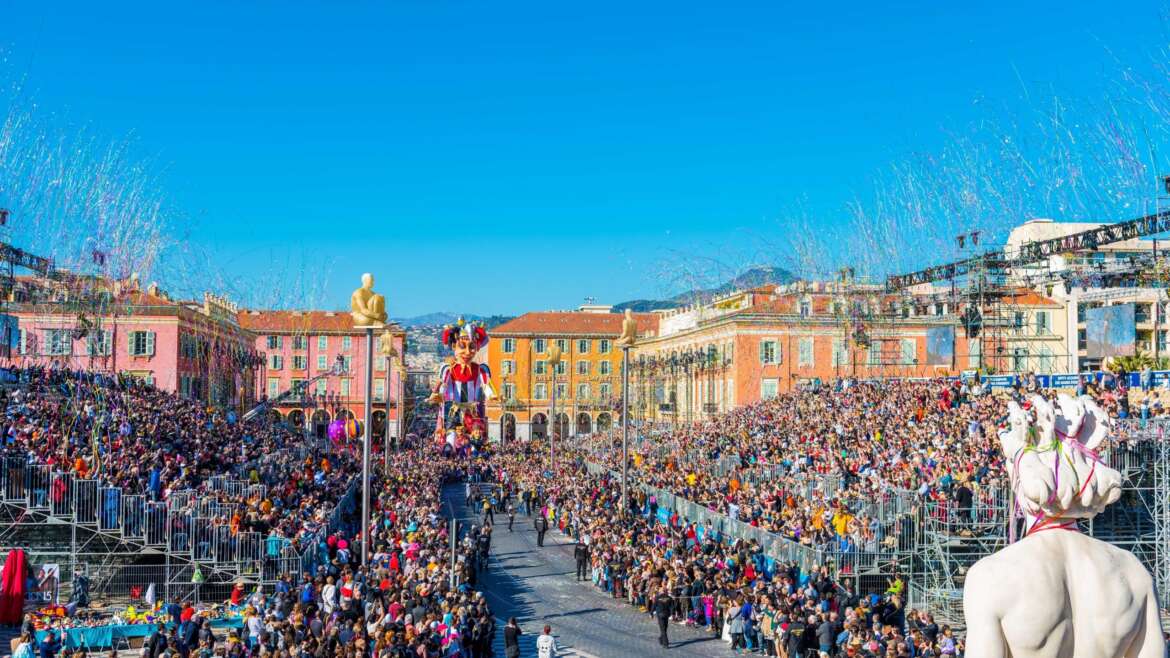
If you happen to be in Nice in February, you quickly realize that winter here doesn’t mean silence. The light is softer than in summer, the sea is a deeper shade of blue, and evenings are cool enough for scarves — yet the city feels charged with anticipation. Banners stretch across boulevards, stages rise in central squares, and there’s a steady hum in the air that suggests something big is about to begin. That “something” is the Nice Carnival, and in 2026 it once again transformed the Riviera’s elegant capital into a place of color, satire, music, and shared celebration.
What strikes you first is the contrast. Nice is known for its refined Belle Époque architecture, palm-lined promenades, and calm Mediterranean rhythm. Carnival interrupts that calm — but gently, playfully, almost mischievously. It doesn’t replace the city’s character; it exaggerates it.
A Tradition That Never Really Stopped
The Nice Carnival isn’t a recent invention designed for tourists. Its roots go back centuries, with references to pre-Lenten festivities recorded as early as the 13th century. Over time, informal masquerades evolved into organized parades with elaborate floats, themed kings, and structured programs. Yet even now, despite modern production techniques and international media coverage, the event retains something old-fashioned at its core.
 In 2026, you could still sense that continuity. Local families spoke about attending “every year.” Schoolchildren created small carnival crafts in the weeks leading up to the main parades. Shop windows displayed playful decorations, and cafés offered special menus inspired by the festivities. Carnival here feels less like a temporary attraction and more like a seasonal rhythm the city naturally follows.
Place Masséna: Where It All Comes Alive
Most of the major parades circle around Place Masséna, Nice’s central square. During carnival season, it is transformed into a kind of open-air theater. Temporary grandstands rise along the perimeter, lighting rigs are mounted across façades, and security checkpoints are installed with quiet efficiency.
When the first parade begins, the atmosphere changes instantly. Music pulses through the square, and suddenly the first float appears — towering, bright, and impossibly detailed. The famous “grosses têtes,” giant caricature heads sculpted from papier-mâché, draw laughter as they roll past. In 2026, the theme centered on imagination and global connections, interpreted through humor. Political figures, cultural trends, environmental issues — all were represented, but always with a light touch. The satire was clever rather than aggressive.
There’s something uniquely communal about sitting in those stands. Strangers comment to each other, point at details, share snacks. Children wave enthusiastically at performers, who often wave back or throw small gifts into the crowd. It feels less like watching a show and more like participating in a citywide conversation conducted through color and exaggeration.
The Flower Parades Along the Promenade
If the main parades are theatrical, the Flower Parades — the famous “Bataille de Fleurs” — are poetic. Held along the Promenade des Anglais, with the Mediterranean stretching endlessly behind them, these processions celebrate the region’s floral heritage.
Nice and its surrounding countryside have long been associated with flower production, especially for perfume and export. The Flower Parades began in the 19th century as a way to showcase this abundance. In 2026, that tradition remained central. Floats were covered in thousands of fresh blooms: mimosa in vibrant yellow, roses in deep red and blush pink, lilies and carnations layered in intricate patterns.
Performers, dressed in coordinated costumes, stood atop these moving gardens. And then the flowers began to fly.
Unlike a real “battle,” the exchange is gentle and joyful. Performers toss bouquets into the audience, and spectators eagerly reach out to catch them. It’s a small, human gesture that transforms the event from spectacle to interaction. By the end of the parade, people leave holding armfuls of blossoms, smiling as if they’ve received unexpected gifts.
In 2026, sustainability featured more prominently than in previous years. Organizers emphasized locally sourced flowers and environmentally responsible materials for float construction. There was a visible effort to reduce waste and rethink logistics without diminishing beauty. It felt like an acknowledgment that celebration and responsibility can coexist.
Nightfall and Illumination
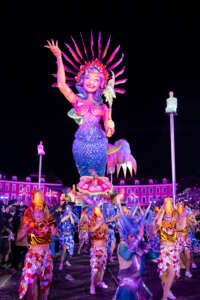
When evening comes, the carnival takes on a different personality. The illuminated night parades are perhaps the most visually striking part of the entire event. As darkness settles over the city, floats glow with LED lighting, shifting colors and highlighting sculpted details that might go unnoticed in daylight.
Music seems louder at night. Drums reverberate between buildings, brass instruments cut through the air, and dancers move with heightened energy. The combination of light and motion creates something almost dreamlike — giant figures drifting through the square, faces blinking, hands moving mechanically, colors reflecting off nearby façades.
And yet, despite the scale, there’s intimacy. Performers make eye contact, exchange gestures, pose for photographs. Carnival in Nice never feels distant or untouchable. The boundary between stage and spectator is thin.
The Art Behind the Spectacle
It’s easy to forget how much labor goes into what appears effortless. Months before February arrives, teams of artists and technicians begin work in specialized workshops. Designers sketch concepts inspired by the annual theme. Sculptors construct metal frameworks. Layers of papier-mâché are applied, sanded, painted, and detailed by hand.
In 2026, certain floats incorporated subtle mechanical elements — rotating components, moving eyes, animated gestures. But the dominant impression remained artisanal. You could see brushstrokes in the paint. You could sense that these figures were built by human hands, not mass-produced in factories.
That craftsmanship gives the carnival authenticity. It feels created, not manufactured.
A Winter Economic Pulse
For Nice, February is traditionally quieter than the summer season. The carnival changes that rhythm dramatically. Hotels report high occupancy rates. Restaurants and cafés along the Promenade des Anglais extend their hours. Even small boutiques benefit from increased foot traffic.
But beyond economics, the carnival provides psychological energy. Winter can feel long, even on the Riviera. The burst of color, music, and collective experience breaks monotony. Locals who might otherwise retreat indoors find themselves staying out late, wrapped in coats but smiling in the glow of parade lights.
Security and Organization
Given the scale of attendance, organization is crucial. In 2026, security measures were visible but not oppressive. Entry points to major parade areas were controlled, and coordination between municipal authorities and event staff ensured smooth crowd flow.
Public transportation schedules were adjusted to accommodate late-night departures. Information booths assisted visitors in multiple languages. Despite the large crowds, the overall atmosphere remained relaxed — a testament to effective planning and local familiarity with hosting large events.
The Carnival King and Farewell
One of the most symbolic traditions of the Nice Carnival is the creation of the Carnival King — a giant figure representing the theme of the year. Throughout the festivities, the King presides over parades, a towering embodiment of the carnival’s spirit.
At the end of the celebration, the King is ceremonially burned. In 2026, as in previous years, the final evening drew thousands to watch. The figure was set alight, flames rising against the dark Mediterranean sky. Fireworks followed, exploding in brilliant patterns over the water.
There is something unexpectedly moving about this moment. After days of music and laughter, the fire introduces reflection. It symbolizes closure, renewal, and the cyclical nature of celebration. The King disappears, and ordinary life resumes.
Everyday Carnival Moments
Not all carnival experiences happen in the grandstands. Some of the most memorable moments occur in smaller settings. A street performer juggling near the Old Town. A group of teenagers in improvised costumes laughing on a side street. The smell of roasted chestnuts mixing with sea air.
Cafés buzz with conversations about favorite floats. Photographers compare shots. Children examine the flowers they managed to catch earlier in the day. The carnival spills beyond official routes into everyday city life.
Why It Endures
There are larger carnivals in the world — more extravagant, more intense. But Nice offers a distinctive balance: elegance paired with satire, tradition blended with innovation, Mediterranean scenery framing centuries-old ritual.
In 2026, that balance felt particularly meaningful. In a world often dominated by serious headlines and digital interactions, the simple act of gathering in a public square to laugh at oversized caricatures carried weight. It reminded participants that community can still form around shared physical experiences.
The Nice Carnival is not merely about floats or flowers. It is about a city choosing, each winter, to express itself loudly and creatively. It is about humor used as commentary rather than division. It is about craftsmanship that honors tradition while embracing new techniques.
As the final fireworks faded and the smoke from the burning King drifted out over the sea, the square slowly emptied. Workers began dismantling stands. Street sweepers cleared confetti. Within days, Place Masséna returned to its everyday elegance.
But something lingers after carnival ends — a slight shift in perspective, perhaps. A reminder that even in the quietest season, color can erupt. That satire can be kind. That flowers can be thrown not in anger, but in celebration.
For those who experienced it in 2026, the Nice Carnival was not just an event on a calendar. It was a vivid pause in winter, a shared story told through light, paper, petals, and fire — and a promise that next February, the city will once again awaken in spectacular fashion.
Planning a trip to French Riviera? Book your private driver here
Add Your Comment